Exploring Your
Current State
1.
Gear Up &
Get Inspired
2.
Dive In &
Try it Out

3.
Capture Insights &
Create Solutions
4.
Launch &
Measure Impact
Exploring Your Current State
Dive In & Try it Out
Now that you’ve learned about what you will explore regarding your current state, it’s time to put your skills into practice!
When exploring your current state, it's crucial to collect two types of data essential for telling your school's story: qualitative and quantitative.
Together, these two types of data provide a complete picture of how students experience school. Start by selecting at least one activity from each data type (qualitative and quantitative). If time permits, you can gather additional information to further enhance your understanding of the current state of your campus.
Qualitative - Pick one or more
1. Shadow a Student
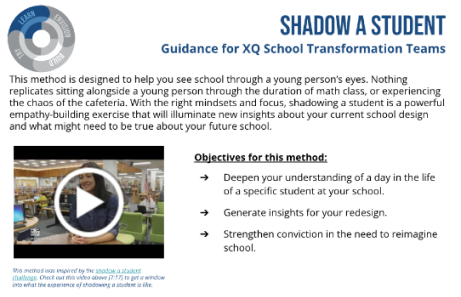
Shadowing a Student involves observing a student's day-to-day experiences to gain firsthand insight into their needs and challenges, making it a vital practice for designing a school that truly supports and engages its students.
Steps:
- Set a learning goal.
- Select students to shadow.
- Create a shadow schedule.
- Debrief your day.
Tips:
- Be Observant: Focus on the student’s experiences, interactions, and emotions throughout the day without interfering.
- Take Detailed Notes: Document key moments and insights that highlight the student’s challenges and successes.
- Reflect Afterwards: Analyze your observations to identify patterns and areas for potential improvement in the school environment.
Click on this guidance to learn more.
Use this Note Catcher to capture insights.
2. Current Conditions
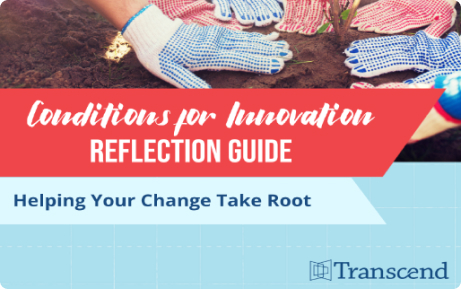
Transcend's Conditions for Innovation reflection is a process of evaluating and providing language for the factors that support or hinder innovation in schools, crucial for creating environments where transformative educational designs can thrive.
Steps:
- Determine why taking the conditions assessment is important and root who you select and the questions you ask around that North star.
- Prepare the questions based on the bank provided.
- Administer the reflection.
- Notice any conditions that stand out and reflect on your findings.
Tips:
- Keep in mind that the conditions are not linear. Your understanding of where you fit in the framework is not a grade of ineffectiveness, but a language for targeting growth.
- Conditions can change over time and may vary based on the model components of your school.
Click on this Conditions Reflection to learn more.
Fill out this form to receive the link to your Conditions Assessment and live results dashboard.
Report example – embed the dashboard.
3. Survey Students
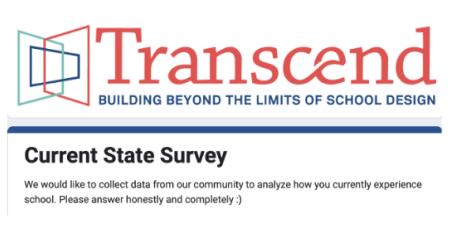
The Current State survey designed to assess how students currently experience school gathers crucial feedback on their daily realities, making it essential for amplifying student voice and informing choices that align with their needs and preferences in the school design process.
Steps:
- Prepare: Select students to survey and create a plan to disseminate surveys electronically through the proper channels.
- Administer the surveys.
- Document insights.
Tips:
- Consider a wide variation of opinions from students who may have varying perspectives.
- Administering the survey during a common time in the school day will maximize participation.
Click on this link to access the survey.
Interviews can also be a great way to analyze your current state, click here to go to interview guidance in the Activating Your Community for Redesign module!
Quantitative - Pick one or more
1. Equity Audit
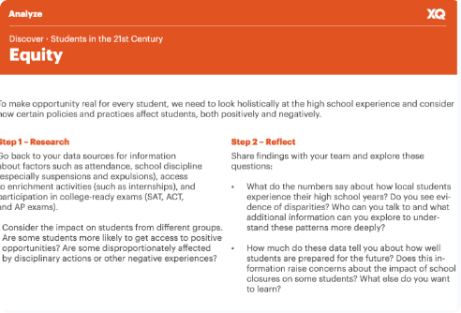
A school Equity Audit examines disparities in resources, opportunities, and outcomes across different student groups, making it vital for understanding the current state of equity within a school and guiding more inclusive practices.
Steps:
- Gather information around the student experience such as attendance, testing, and discipline data.
- Note any trends or themes that arise.
- Discuss these findings with your team.
Tips:
- Collect Disaggregated Data: Analyze student performance, discipline, and resource allocation across different demographics to identify disparities.
- Conduct Surveys and Focus Groups: Gather input from students, parents, and staff to understand perceptions of fairness and access.
- Review School Policies: Examine existing policies and practices to assess their impact on equity and identify areas for improvement.
Document your findings in the Equity Audit worksheet.
2. Graduation Rates
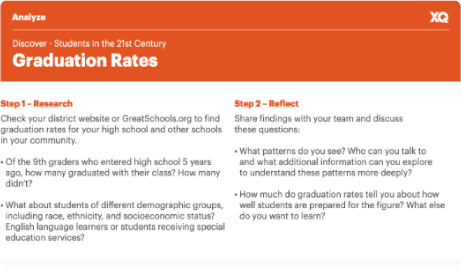
Graduation rates reflect the percentage of students who successfully complete their high school education on time, serving as a key indicator of a school's effectiveness in supporting students to reach this critical milestone.
Steps:
- Gather information around the graduation rates and course completion
- Note any trends or themes that arise.
- Discuss these findings with your team.
Tips:
- Use Accurate Data: Ensure records are up-to-date and verified for precision in calculating graduation rates.
- Track Cohorts: Monitor specific student groups from freshman year through graduation to identify trends and patterns.
- Disaggregate Data: Break down graduation rates by demographics to understand disparities and target interventions.
Document your findings in the Graduation Rates worksheet.
3. College Readiness
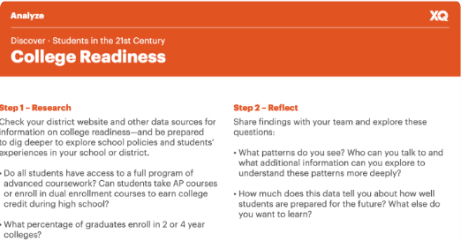
Assessing college readiness evaluates how well students are prepared for post-secondary education, providing important insights into a school's ability to equip students with the necessary skills and knowledge for success beyond high school.
Steps:
- Gather information around the enrichment courses, students who enter 2 or 4 year institutions, and college readiness testing.
- Note any trends or themes that arise.
- Discuss these findings with your team.
Tips:
- Utilize Standardized Assessments: Collect data from exams like the SAT, ACT, or AP tests to gauge academic preparedness.
- Track Coursework Completion: Monitor student progress in advanced courses like honors, AP, or dual enrollment to assess readiness.
- Survey Alumni: Gather feedback from recent graduates on their post-secondary experiences to evaluate how well the school prepared them for college.
Document your findings in the College Readiness worksheet.